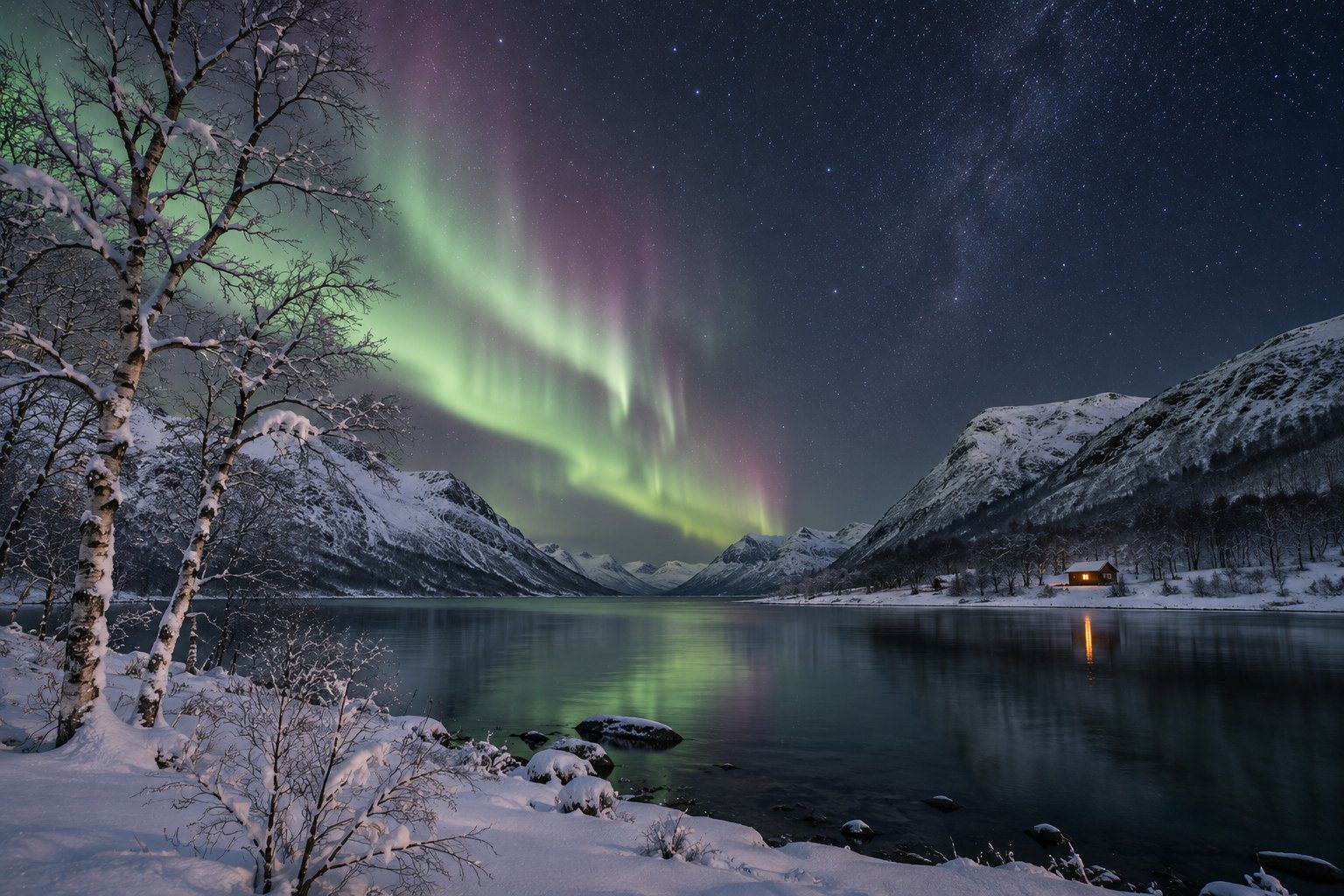
Seeing the northern lights is one of those trips that sounds expensive and a bit of a gamble, and both of those things are true. It is also very doable from the UK, with direct flights to Arctic Norway and a short hop to Iceland. And if you are lucky, you might not need to leave the country at all.
This guide covers where to go, when to book, how many nights to give yourself and roughly what it costs, plus the small mistakes that cost people their best chance.
The short version
- Best bet for most people: Tromsø in Norway. Direct flights from several UK airports, lots of tours, and an easy city to stay in.
- Best months: late September to March. The equinoxes (late September and March) are often a little more intense.
- How long to stay: at least three or four nights. Up to seven is better.
- Cheapest try: Scotland, on a clear night when the forecast is strong. Free, but you cannot plan it.
- Most expensive: a glass igloo in Finnish Lapland. Think hundreds of euros a night.
- Nothing is guaranteed. Any company promising a sighting is selling, not forecasting.
What the northern lights actually are
The lights happen when particles from the sun hit gases high in our atmosphere. Most of what you see is pale green, with occasional pink, purple or blue at the edges. In Shetland they have a lovely name for them: the "mirrie dancers".
One honest note about what to expect. Photos online are long exposures. To your eye, a weak display can look like a faint grey or greenish cloud, and phone cameras often show it better than you can see it. A strong display is a different thing entirely, with moving curtains of green across the sky.
When to go
You need darkness, so it is an autumn and winter trip. The window runs roughly from late September to March or April, depending on how far north you are.
- Time of night: the best viewing is usually between about 9pm and 2am.
- Equinoxes: displays tend to be a little stronger for a few days around the equinoxes in late September and March.
- Mid-winter: the longest nights, but also the coldest weather and the highest prices.
- Shoulder months: September, October, February and March are often cheaper, with decent chances.
The solar cycle. The sun works on a cycle of about 11 years, and the last peak was around October 2024. Auroras generally stay good for up to two years after a peak, so this winter should still be worth the trip. After that, activity falls and you will usually need to travel further north to see it. If you have been thinking about it, sooner is better than later.
Where to go
Tromsø, Norway
The most accessible option in Europe, and the one we would pick for a first trip. There are direct flights from London Heathrow, Gatwick, Luton and Manchester, and from Bristol on some winter schedules, though routes change each season so check before you book.
You stay in the city and join an evening tour that drives out to find clear skies. That is the key advantage: guides watch the cloud and move you, sometimes crossing into Finland or Sweden to find a gap.
Typical tour prices (from, in US dollars):
- Large heated bus chase: about $91 for around 7 hours
- Small minibus group: about $130
- Photography tour: about $107
- Catamaran trip: about $143, thermal suits provided
- Husky and Sami experiences: about $111 to $160
A package example. A Glasgow to Tromsø package with three nights at the Moxy Hotel, direct flights, a bag and breakfast has been listed from £985 per person for December 2026. Optional excursions are extra, so tour costs go on top.
If you would rather book a tour on its own, the Northern Lights Adventure in Tromsø with a local guide is a good place to start. Check the current price, group size and cancellation terms on the page.
Iceland
Quick to reach from the UK and easy to combine with sightseeing, so the trip is not only about the lights. Reykjavík is a good base, and tours leave from the city. The weather is changeable and cloud is a real risk, so the north around Akureyri tends to have more clear nights than the west or south coast.
Package examples:
- A 5-day, 4-night Reykjavík break with flights, bed and breakfast, a city tour and a northern lights tour has been listed from £1,036 per person for late January 2027, or from £1,189 for late February.
- A 7-night guided coach tour with a northern lights programme has been listed from £2,395 per person, with flights, hotels and several sights included.
If you are already in Reykjavík, you can also book a tour on its own: a northern lights bus tour for the lower price, or a small group northern lights hunt if you would rather not share a bus with dozens of people. Check group size, price and what happens on a cloudy night before you book. If you want to explore by car in winter, compare prices on DiscoverCars.
Finnish Lapland
The classic snowy Christmas card version, with husky rides, reindeer and glass igloos. You can fly to Ivalo and be at Saariselkä in around 30 minutes, or fly to Rovaniemi, which is better for families and Santa, but further south and less reliable for the lights unless activity is strong.
The glass igloo reality check. At Kakslauttanen, small glass igloos have been listed from about €850 a night in peak winter (28 November to the end of February), or about €750 in the shoulder months, with half board. Lunch, activities and transfers are extra. It is a beautiful experience, but it is a pricey way to wait for something you cannot guarantee, so many people book one or two igloo nights and spend the rest in a cabin.
Abisko, Sweden
Often described as one of the best places in Europe because of its dry climate and clear skies, but it is harder to reach. Flight connections are limited, so most people take the train. A good option for a longer, more adventurous trip.
Scotland and the rest of the UK
You do not need a passport, and on a strong night the lights have been seen as far south as Kent and Cornwall. The catch is that you cannot plan for it. You are relying on a strong burst of solar activity, a clear sky and dark surroundings all at once.
If you want to try:
- Go north. Shetland, Orkney, Caithness, the far north west (Applecross to Thurso), Lewis, Harris and northern Skye give the best odds.
- Dark sky spots. Galloway Forest Park (the UK's first International Dark Sky Park), Rannoch Moor, the Cairngorms and the Moray coast are all good.
- Elsewhere in the UK. Northumberland, the Yorkshire Dales and Bannau Brycheiniog (the Brecon Beacons) all have dark sky status.
- Look north. You need a clear view of the northern horizon.
- Timing. Winter, around midnight, from roughly two hours before to two hours after.
If you are heading to Scotland, compare car hire prices on DiscoverCars, because the best dark spots are rarely on a bus route.
How many nights do you need?
This is the thing most people get wrong. A single night is a gamble. Cloud can wipe out a short trip, and activity comes and goes.
- Three nights: the minimum we would book.
- Four to five nights: a much better spread of chances.
- Up to seven: best of all, and you can rest on a cloudy night.
Book the tour on your first night, not your last. If it is cloudy, you still have time to try again. Many operators will let you rebook a cloudy night, so ask before you pay.
Checking the forecast
You do not need to be an expert, but a few terms help.
- Kp index: a scale from 0 to 9. Roughly, 0 to 2 is low, 3 to 4 medium, 5 to 6 high and 7 to 9 very high. The further north you are, the less you need. In Scotland you need a high number. In Tromsø, a medium reading can be enough.
- Cloud cover: just as important as Kp. A huge storm behind thick cloud is invisible.
- Apps: AuroraWatch UK, built by scientists at Lancaster University, sends alerts for the UK. "My Aurora Forecast" is a popular app for forecasts and alerts, with a paid version for around £2.99. The Met Office also posts space weather updates.
Forecasts only look a few days ahead and they can be wrong, so treat them as a guide rather than a promise.
What to wear
You will be standing still, outside, in the dark, for hours. That is much colder than walking around.
- Layers: a thermal base layer, a fleece or wool mid layer and a windproof outer layer.
- Warm socks and proper winter boots, with room for two pairs of socks.
- A hat, a scarf and gloves, with thin liners underneath so you can use your phone.
- Hand warmers are cheap and make a big difference.
Many Arctic tours provide thermal suits, but check what is included before you pay.
Photographing the lights on your phone
- Use night mode or a long exposure setting.
- Prop the phone on something solid or use a small tripod. Even a hand shake blurs a long exposure.
- Turn off the flash.
- Keep spare battery power, because cold drains batteries quickly. Keep the phone in an inside pocket between shots.
- Do not forget to look up. Spend more time watching than photographing.
What it costs
These are rough guides based on current listings. Prices move a lot with dates and how early you book.
| Trip | Rough cost |
|---|---|
| Scotland, on a clear night | Free, plus travel and accommodation |
| Tromsø package, 3 nights with flights (December) | From about £985 per person |
| Tromsø evening tour, once there | About $90 to $145 per person |
| Iceland 4-night break with flights and a lights tour | From about £1,036 per person |
| Guided Iceland coach tour, 7 nights | From about £2,395 per person |
| Glass igloo at Kakslauttanen | From about €750 to €850 a night |
Cheaper tends to mean bigger groups, a bus and fewer choices. Paying more usually means smaller groups and more flexibility, but never a guarantee.
Before you go
- Travel insurance. This is a cold-weather trip with icy ground and flights that can be disrupted. SafetyWing is one option to compare, and check what your policy covers for winter activities.
- Flights. Direct routes to Tromsø are seasonal, so book early and check the timetable.
- Winter driving. If you hire a car in Iceland or Lapland, check whether it has winter tyres and what the insurance covers.
- Book flexible. Where you can, choose changeable tickets and hotels, because weather is the whole point.
- Pack for darkness. A head torch is useful.
Our verdict
If it is your first time and you want the best chance without a huge budget, pick Tromsø, stay four nights, book your tour early and go in September, October, February or March, when it is cheaper. If you would rather try something free and local, keep an eye on the AuroraWatch alerts and head for the nearest dark sky on a clear night.
Whatever you choose, treat the lights as a bonus. If you go for the snow, the food, the huskies and the dark, a green sky becomes the best part rather than the whole reason.
Planning more? See all our travel guides for UK travellers.
Where this comes from
Opening times and prices change, so this is a snapshot checked on 8 November 2026. These are the sources it draws on:
- Where to go and when: Best places to see the northern lights, Weather2Travel
- UK dark sky spots: Where to see the northern lights in the UK, Which?
- Scotland: Look out for the aurora in Scotland, NatureScot
- Tromsø tours: Northern lights tours from Tromsø, Capture the Atlas
- Tromsø package: Glasgow to Tromsø Northern Lights Escape, Regent Holidays
- Flights: Direct flights to Tromsø in winter, Best Arctic
- Iceland package: Iceland and the Northern Lights, Newmarket Holidays
- Iceland coach tour: The Northern Lights Explorer, All Iceland
- Glass igloos: Kakslauttanen Arctic Resort review, Finding the Universe
- Apps: Northern lights apps, Yorkshire Post